What are AAIF's four new projects, from Agent Skills to OpenSandbox?
The Agentic AI Foundation added Agent Skills, Open Responses, OpenEnv and OpenSandbox on October 22, 2026, bringing it to 10 vendor-neutral projects.
Key takeaways
- On October 22, 2026, the Agentic AI Foundation added four projects and now hosts 10.
- Anthropic handed over the Agent Skills name, logo, GitHub organization and agentskills.io domain.
- Open Responses is an open, multi-provider specification based on the OpenAI Responses API.
- The Agent Skills roadmap proposes versioned releases and security guidance.
On this page
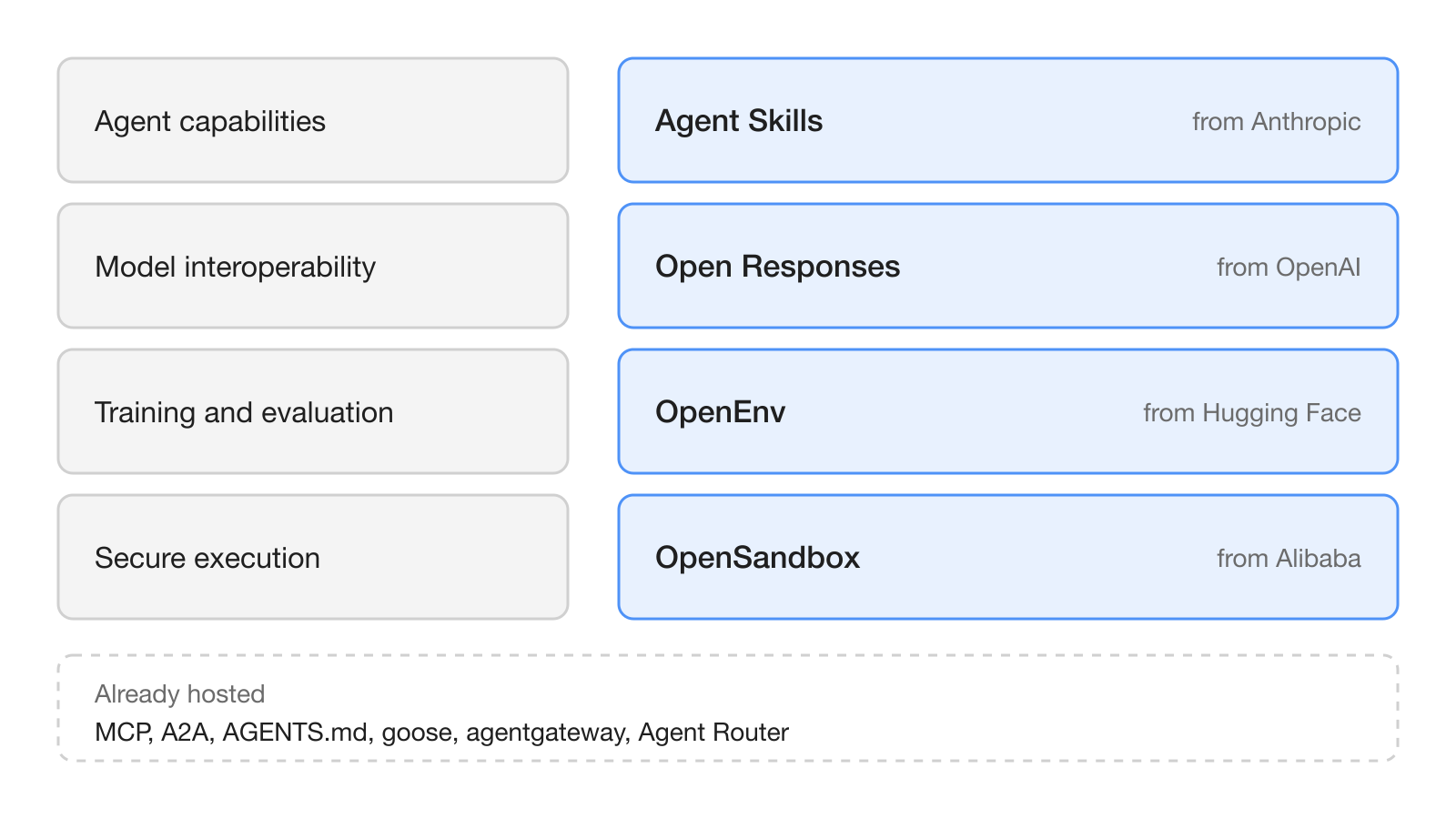
On October 22, 2026, the Agentic AI Foundation (AAIF) took in four new projects: Agent Skills from Anthropic, Open Responses from OpenAI, OpenEnv from Hugging Face and OpenSandbox from Alibaba. That brings the foundation to 10 hosted projects [1]. AAIF operates under the Linux Foundation [2]. Each new project covers one layer of an agent stack: skills, a cross-provider model API, training environments and sandboxed execution. All four now sit under vendor-neutral governance next to MCP and A2A.
What did the Agentic AI Foundation announce?
AAIF announced the four projects at AGNTCon + MCPCon North America in San Jose. The conference ran October 22 to 23, 2026 [1]. The foundation launched in December 2025 with three projects (the Model Context Protocol, goose and AGENTS.md) and since then has added Agent2Agent (A2A), Agent Router and agentgateway [1]. The four new contributions bring the total to 10.
These are existing projects changing hands, not new products. AAIF sorts them into four layers of the agentic stack: agent capabilities, model interoperability, training and evaluation, and secure execution [1]. Manik Surtani, AAIF's CTO and co-founder, framed it this way: "A year ago, AAIF launched with three projects and a bet that agentic AI needed a neutral home to thrive." [1]
| Project | Contributed by | What it is | License |
|---|---|---|---|
| Agent Skills | Anthropic | Folder format that packages instructions, scripts and resources for agents | Code Apache 2.0, docs CC-BY-4.0 |
| Open Responses | OpenAI | Open specification for a multi-provider LLM interface, based on the OpenAI Responses API | Apache-2.0 |
| OpenEnv | Hugging Face | Framework and hub for reinforcement learning environments | BSD 3-Clause |
| OpenSandbox | Alibaba | General-purpose sandbox platform for AI applications | Apache 2.0 |
The descriptions come from the announcement [1]. The licenses come from each project's repository [4][5][6][7].
What changes for Agent Skills?
Agent Skills gets a neutral owner; the donation itself does not announce any change to the format. Anthropic is handing over the Agent Skills name and logo, the GitHub organization and the agentskills.io domain [2]. Engineers from Anthropic, Google, OpenAI and other companies will maintain the standard as individuals, with David Soria Parra and Mahesh Murag as Lead Maintainers. You do not have to join AAIF to use the standard or contribute to it.
Anthropic says more than 70 agent platforms have integrated the standard since it was published in December 2025, including ChatGPT, Cursor, GitHub Copilot and VS Code. It also counts 1 million published skills and nearly 280 million installs [2]. The proposed roadmap starts with three items: versioned releases, a formal proposal process, and security guidance for people who write and install skills.
The format itself is small. A skill is a directory with a SKILL.md file, made of YAML frontmatter followed by Markdown instructions. Optional scripts/, references/ and assets/ folders sit next to it [3]. Only name and description are required:
---
name: release-notes
description: Drafts release notes from merged pull requests. Use when the user asks for a changelog or release summary.
license: Apache-2.0
---

1. List the pull requests merged since the last tag.
2. Group them by area and write one line per change.
The name must be 1 to 64 lowercase letters, digits or hyphens, with no hyphen at the start or end and no two hyphens in a row. It must also match the folder name. The description can be up to 1,024 characters [3]. Optional fields are license, compatibility (up to 500 characters), metadata, and an experimental allowed-tools.
How do the other three projects fit together?
Each of the other three fills a gap that Agent Skills and MCP leave open: which model API you call, where the agent's code runs, and how you train or evaluate the agent.
Open Responses is an open specification for multi-provider, interoperable LLM interfaces, based on the OpenAI Responses API. It defines a shared schema, consistent streaming events and extensible tooling [1]. The repository publishes the spec as an OpenAPI document with dated, immutable releases. It also ships a compliance test runner that you point at any server's base URL. Each request in that runner has a 30-second deadline [5].
OpenSandbox is a general-purpose sandbox platform for coding agents, GUI agents, agent evaluation, AI code execution and RL training. It includes a sandbox protocol that defines lifecycle and execution APIs, so teams can add their own runtimes [1]. The repository lists SDKs for Python, Java/Kotlin, TypeScript/JavaScript, C#/.NET and Go, plus an osb CLI and an MCP server. It runs on Docker locally and on Kubernetes in a cluster, and a Firecracker-based runtime supports pause and resume [6].
OpenEnv is a framework and community hub for reinforcement learning environments. Each environment runs as a containerized service that exposes an agent interface, MCP and Gym [1]. Every environment uses the same reset(), step() and state() calls. The README lists more than 40 ready-made environments and warns that "OpenEnv is in early development, so APIs may still change" [7].
What does this mean for teams running AI agents?
For teams, the four projects make it easier to switch vendors at each layer. A skill written once can load in any of the 70-plus platforms that support the format [2]. An app written against Open Responses can switch model providers with little translation [1]. And sandboxes that follow one protocol can move between a laptop and a Kubernetes cluster [6].
Neutral governance also changes who you talk to. Change proposals for Agent Skills now go through the community process Anthropic describes, with feedback taken on the project's Discord [2]. Alibaba gave the same reason for OpenSandbox: "we don't want its future to be defined by a single company" [1].
How do you check your setup this week?
The announcement does not list any required changes to existing skills, but a validator is a quick way to confirm your skills follow the format before more tools start enforcing it. The specification points to the skills-ref reference library for this [3]:
skills-ref validate ./my-skillA short checklist for teams:
- Run
skills-ref validateon every skill your agents load, and fix names that do not match their folder. - Keep each
SKILL.mdunder 500 lines and move detail intoreferences/. The specification recommends instructions under 5,000 tokens because the whole file loads when a skill activates [3]. - If you run a gateway or proxy that speaks the Responses API shape, run the Open Responses compliance suite against it (
bun run test:compliance --helplists the flags) [5]. - If you build your own agent sandboxes, compare your lifecycle API with the OpenSandbox protocol before you add another runtime [6].
What are the limits and open questions?
The governance change is real. The technical roadmap is still a proposal. For Agent Skills, versioned releases and a formal proposal process are roadmap items, not shipped features. Security guidance for installing skills is also still on the roadmap [2]. Until it ships, treat a third-party skill like any other code you install. Read its scripts before your agents run them.
The allowed-tools field, which lists the tools a skill is pre-approved to use, is marked experimental, and support varies between agent implementations [3]. Don't rely on it as a security boundary. OpenEnv warns that its APIs may still change [7]. And the announcement gives no version numbers or dates for any of the four projects' next releases [1]. It also does not say whether the Agent Skills specification will move to dated releases the way Open Responses already has.
Frequently asked questions
Do I have to change my SKILL.md files after the Agent Skills donation?
The donation transfers the Agent Skills name, GitHub organization and agentskills.io domain to the Agentic AI Foundation, and the announcement lists no required changes to existing skills. Running skills-ref validate is a quick way to check that a skill conforms to the specification.
Do you need to join the Agentic AI Foundation to use Agent Skills?
No. Anthropic says anyone can use or contribute to the Agent Skills standard without becoming a member of the Agentic AI Foundation.
What is Open Responses?
Open Responses is an open specification for interoperable LLM interfaces across model providers, based on the OpenAI Responses API. It defines a shared schema, consistent streaming events and extensible tooling, and its repository includes a compliance test runner for any endpoint.
Which projects does the Agentic AI Foundation host now?
As of October 22, 2026 it hosts 10: Model Context Protocol, goose, AGENTS.md, Agent2Agent, Agent Router, agentgateway, Agent Skills, Open Responses, OpenEnv and OpenSandbox.
Is OpenEnv stable enough for production training pipelines?
Not yet by its own account. The OpenEnv README says the project is in early development and that its APIs may still change.